Mount Union borough
Strickler's Store and Gas Station
Photograph not reproduced here. The image that goes with this story is held by huntingdoncountyhistory.com and its credit does not permit republication, so it is cited rather than copied. See the original.
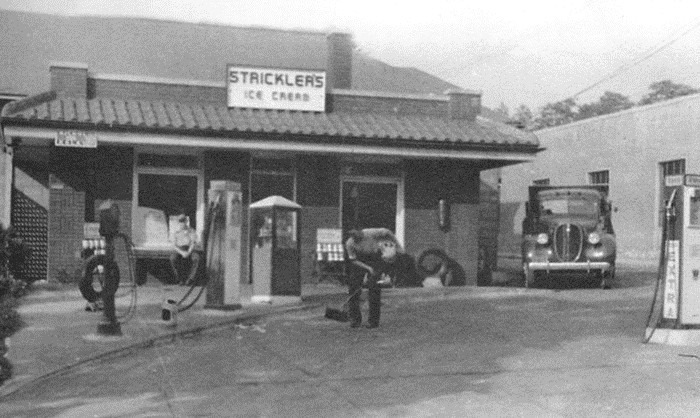
Strickler's in the 1950s, full service in every way: pump your gas, fix your car, sell you a cold drink, and maybe a sandwich for the road. By the 1960s, these corner stores were vanishing, replaced by gas stations and convenience chains that didn't know your name.
From the record
Passages about this subject, quoted from county histories now in the public domain. Each one names the book and the position in the text so it can be checked. Spelling is as printed.
Lodges of various benevolent societies are located here ; Juniata Grange, Patrons of Husbandry, was organized in 1874; there are churches of different faiths, the Shaver's Creek Bank, several good stores and in 1910 the population was reported as being 705. Rock Hill (postoffice name Rockhill Furnace) was laid out in 1874 across the Black Log creek from Orbisonia. A large number of the early houses were built and owned by the Rockhill Iron and Coal Company. An iron furnace was opened at this place in 1831 by Diven & Morrison. The Winchester furnace was built two or three years later. Sims as the first chief burgess. It is a station on the East Broad Top railroad and in 1910 reported a population of 504. Saltillo, a station on the East Broad Top railroad in the southern part of the county, was settled in 1796 by Henry Hubbell. On August 20, 1796, Thomas Greer filed for record the plat of "Springville," which occupied the site of Saltillo. Brewster were the first merchants. A number of lots were sold to people in Philadelphia and other places, but the lack of transportation facilities caused many of the purchasers to surrender their claims and Springville died a natural death.John W. Jordan, ed., History of the Juniata Valley and Its People (New York: Lewis Historical Publishing, 1913) · character 232,854 of the scanned text
Few boroughs in the state show as great an increase in population and wealth during the last twenty years as Mount Union, Orbisonia, a station on the East Broad Top railroad, which connects with the Pennsylvania at Mount Union, is the largest town in the southeastern part of the county. As early as 1760 George Irvin had an Indian trading post at this point. The Bedford furnace was opened in 1785 and two years later a grist mill was started. Another mill was built by Hezekiah Crownover in 1812. The store of Cromwell & Cornelius was opened in 1824, a postoffice was established in 1830 in Taylor Crownover's store, there were two distilleries in 1833 and in 1836 Jonathan Carothers opened the Eagle Hotel. Up to this time the town, like Topsy in Uncle Tom's Cabin, "just growed." There were no streets and the lots were of irregular size, straggling along on either side of the road. In May, 1850, it was regularly laid out and named Orbisonia, for Thomas E. The growth of the town continued and on November 23, 1855, it was incorporated as a borough, with Simon Gratz as the first chief burgess. Orbisonia has two banks, a weekly newspaper, churches of different denominations, a good retail trade with the surrounding country and in 1910 the population was 618.John W. Jordan, ed., History of the Juniata Valley and Its People (New York: Lewis Historical Publishing, 1913) · character 230,296 of the scanned text
The town now composes Northumberland county. The enemy have burnt every where you have been, houses, barns, rye, wheat in the, fields, stacks of hay, &c., &c., is all consumed. Such devastation I have never yet seen. I write this in haste, an<l ^ Am, sir, your most obedient and humble servant, Mathew Smith. NORTHUMBERLAND, Nearly opposite Sunbury, built on the point of land between the North and West Branches of the Susquehanna, at their junction. The town was laid out about the year 1775, by Reuben Haynes, originally from Philadelphia. At first its progress was slow, as all the inhabitants during the revolution were obliged to escape being murdered by a cruel enemy, to flee and sees: refuge at Fort Augusta. It "was not till 1784 or ^5, that Northumberland was again re-occupied ; and in 10 or 12 years afterwards it numbered nearly 100 houses ; at present it contains about 160. The town was incorporated as a borough April 14, 1828. It contains four churches, Old and New School Presbyterian, German Reformed, and Methodist , an academy, a market house, a bank, a town house of brick, and fn 1840 contained 6 stores, several taverns, 3 scholars, 190 scholars, and a number oi mechanics shops. Its locality is inviting to the recluse. The country expands behind the town in a semi-circular form, rising in gentle swells towards Montour's ridge, which crosses between the two rivers at a distance of about 3 miles.I. Daniel Rupp, History and Topography of Northumberland, Huntingdon, Mifflin, Centre, Union, Columbia, Juniata and Clinton Counties (Lancaster, 1847) · character 394,304 of the scanned text
Sources
- catalog h39 facts
- Photograph credit: huntingdoncountyhistory.com
Checked 2026-08-05 · Historic Mount Union collection